
Fuel Advances and Fuel Programs for Truckers: What They Cost, Checked on 11 Vendor Sites
A fuel advance and a fuel discount program are sold together but priced very differently. We read 11 vendor sites in September 2026: what an advance costs where it is published, and what stands behind each per-gallon savings claim.

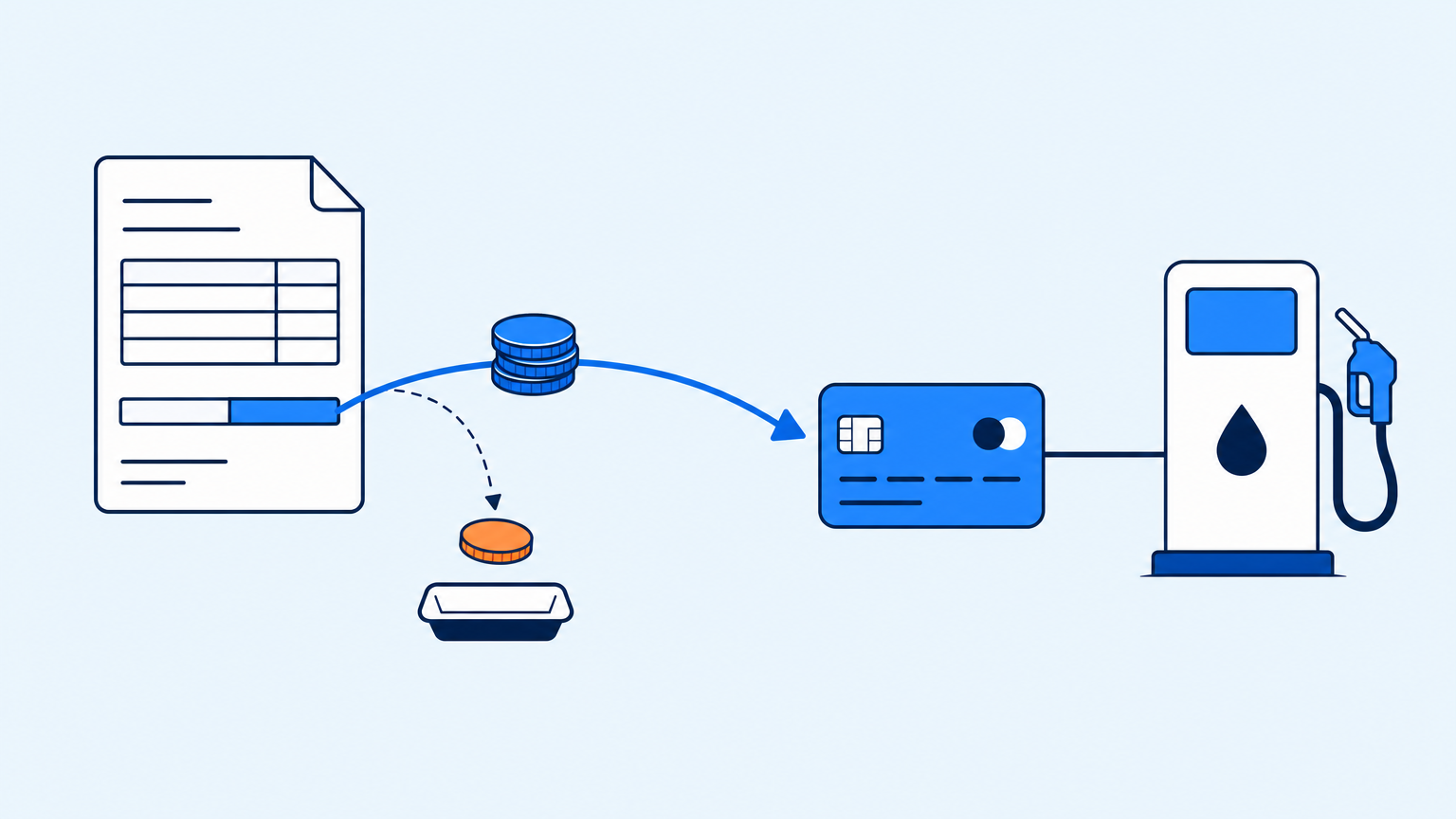
Quick answer: a fuel advance is cash against a load you have not been paid for yet; a fuel program is a discount on the diesel you buy with that cash. They are sold as one package and priced as two. We read 11 websites of factoring companies, fuel card issuers and payment networks on 23 September 2026. Only one of them, OTR Solutions, publishes a dollar price for a fuel advance: $15 to its own fuel card, $24 through Comchek. Eight publish a per-gallon savings number, and only four of those say what the number is based on.
Checked and updated 23 September 2026. Every quote below was read on the vendor's own site that day.
The practical upshot: the discount is what gets advertised, and the advance is what gets used. If you run on advances every week, the advance terms decide more of your fuel cost than the headline cents per gallon do.
Two Different Things Are Called a "Fuel Advance"
1. An advance from your factoring company. You factor a load, and before delivery the factor sends part of what the load will pay onto your fuel card. OTR Solutions describes it as "upfront funds, up to 50% of the linehaul, to cover expenses before a load is delivered", with "the advance amount … simply deducted from the carrier's final payment." TBS says "we can advance you up to 50% on any load you factor", subject to approval, and asks for the rate sheet and BOL with the request.
2. An advance from the broker or shipper, paid through a payment network rather than a card program. Brokers issue a code, the driver redeems it at the fuel desk or as cash, and the amount comes off the settlement. The three networks you will meet:
- Comdata Comchek: "transfer funds electronically, peer-to-peer among all registered OnRoad cardholders, including drivers, brokers", described as "the best way to get instant funds to drivers on the road."
- EFS Checks and MoneyCodes: "Ideal for brokers, Checks and MoneyCodes provide immediate payment."
- Relay: "freight brokers can provide their carriers with RelayCodes for fuel", which are "single-use."
None of the three publishes the fee on its own site. The fee on a broker advance is set by the broker, so ask for it on the rate confirmation, not after the load.
If you are leased onto a carrier, a third version applies: the carrier advances you money under your lease. Federal leasing rules at 49 CFR 376 allow escrow funds to be used "to repay advances" and require the lease to "clearly specify the responsibility of each party with respect to the cost of fuel." The federal broker rule, 49 CFR 371, does not mention advances at all.
What an Advance Costs: One Vendor Publishes It
Program | Advance on a load | Advance fee on its own site | Credit check |
|---|---|---|---|
OTR Solutions | "up to 50% of the linehaul" | "$15" to the OTR Fuel Card, "$24" via Comchek | "no personal or business credit checks required" |
TBS (Triumph) | "up to 50% on any load you factor" | Not published | "*Subject to approval" |
RTS | "Advances" listed as a service, no terms | Not published | Self-Funded card "regardless of credit score" |
eCapital (formerly TAFS) | No fuel advance terms published | Not published | "no credit check" on the fuel program |
Comdata Comchek, EFS MoneyCodes, Relay | Set by the broker | Not published |
A price you have to ask for is still a price. Ask it in writing before the first advance, and ask whether it is per advance or per load.
The Arithmetic: What a Flat Advance Fee Does to Your Price per Gallon
A flat fee reads small until you spread it over the fuel it buys. Mudflap's own FAQ uses a fill of 75% of a 300-gallon capacity, which is 225 gallons, so take that as one fill-up:
Advance route | Fee | Cost per gallon on one 225-gallon fill |
|---|---|---|
OTR, to the OTR Fuel Card | $15 | 6.7 cents |
OTR, via Comchek | $24 | 10.7 cents |
That is not a reason to avoid advances; a truck without fuel earns nothing. It is a reason to compare the fee with the discount you will actually get on those gallons. If a program's real in-network saving on your lanes is 30 cents, a $24 advance takes a third of it. Two small advances in one week cost more than one well-timed one.
Per-Gallon Savings: What Each Site Claims, and What Stands Behind It
Ratings are the TruckMyApps directory score on 23 September 2026.
Program | Claim on its own site | Basis stated | TMA rating |
|---|---|---|---|
"save an average of 51¢ per gallon at TCS in-network fuel locations" | "based on Q1 2026 TCS client transactions" | 3.7 (22 reviews) | |
Triumph / TBS | "*Average savings of 59 cents per gallon" | "based on actual in-network TCS client transaction for Q2 of 2026" | not listed |
"Save up to $1.00 per gallon"; "Save up to $130 per fill-up in network" | $130 "based on filling 75% of a 300-gallon capacity … between May 2024 and July 2024" | 3.9 (24 reviews) | |
Coast | "a rebate of up to 9¢ per gallon" | "calculated using line-item transaction data from participating fuel merchants" | not listed |
"Save an average of 45 cents per gallon" | None published | 4.0 (12 reviews) | |
OTR Solutions | "average savings of $0.50/gallon, or $7,200/year per truck" | None published | not listed |
eCapital (TAFS) | "average savings of $0.43 per gallon at in-network locations, with savings up to $2.40 at select locations" | None published | not listed |
TBS fuel card | "Save up to $0.90 per gallon" | None published | not listed |
Three things stand out.
- Two of the stated bases are the same network. TruckSmarter's 51 cents and Triumph's 59 cents both come from TCS client transactions, one from Q1 2026 and one from Q2. Same pumps, different quarter, eight cents apart.
- "Up to" is a ceiling, "average" is a middle. Mudflap and TBS quote ceilings. RTS, OTR and eCapital quote averages without saying whose average.
- In-network is the whole claim. RTS says it plainly: "You cannot access your fuel discounts at out-of-network stations." Mudflap is the only one here that promises a floor off-network: a minimum discount of 2 cents a gallon, even out of network.
The number on the homepage is compiled from other carriers' lanes, not confirmed on yours. The only saving that is yours is the one on your own fuel receipts.
Apex Capital and AtoB returned blocked pages to every read we made on 23 September 2026, so they are not in either table.
Which Setup Fits Which Carrier
- You already factor. Start with your factor's own card and advance program, because that is where the advance lands. At OTR it is also the cheaper route: $15 to its own card against $24 via Comchek. OTR also offers "up to 0.5% off your factoring rate" when you use both.
- Thin credit, no factoring yet. Look at cash-secured or prepaid cards: TruckSmarter's "does not require a credit check", RTS Self-Funded works "regardless of credit score", and eCapital offers "$2,500 in pre-approved credit" with "no credit check." You fund the card, so there is no advance, only the discount.
- You run on broker advances. Your fuel program matters less than the broker's fee on each Comchek or EFS code. Get that fee on the rate con.
- Box trucks and vans buying at retail stations. Coast's rebate is "at brands like Exxon, Mobil, 7-Eleven, Speedway, Casey's, Circle K, Shell", not truck stops, at "$4 per active user per month" with "NO per-transaction fees in the US."
For a ranked comparison of the cards themselves, see our best fuel cards for truckers. The full list is in the fuel management category.
Five Questions to Ask Before You Sign
1. What does one advance cost, flat or percentage, and is it charged per advance or per load?
2. What share of the load can be advanced, and what paperwork triggers it?
3. What was the per-gallon saving on my lanes last quarter, not the network average?
4. What do I pay out of network, and is there a funding fee when I load the card by credit card?
5. If I stop factoring, does the fuel card and its credit line stay?
Cheap fuel on an expensive advance is not cheap fuel.
If you have run on advances from any of these programs, a review on its TruckMyApps page tells the next carrier what the fee really was.
FAQ
What is a fuel advance in trucking?
Money paid to a carrier before a load is delivered, to buy fuel for that load. It comes from a factoring company, from the broker through a code such as Comchek or an EFS MoneyCode, or from the carrier you are leased to, and it is deducted from the final payment.
How much does a fuel advance cost?
Of the 11 sites we read, only OTR Solutions publishes it: $15 per advance to its fuel card and $24 via Comchek. Everyone else sets it in the agreement, so ask for it in writing.
How much of a load can be advanced?
OTR and TBS both publish "up to 50%" of the load.
Are fuel discount claims reliable?
Four of eight publish a basis for the number. Treat every figure as a network average or a ceiling, and compare it with your own receipts after a month.
Do fuel discounts work at any truck stop?
Usually only in network. RTS says outright that discounts are not available out of network; Mudflap promises a 2-cent minimum off-network.