
Truck Load Management Software: What the Category Actually Contains
“Truck load management software” is not one product. It covers four separate jobs sold as four different purchases: sourcing, planning, execution and tracking. How to tell which shelf you are really shopping.

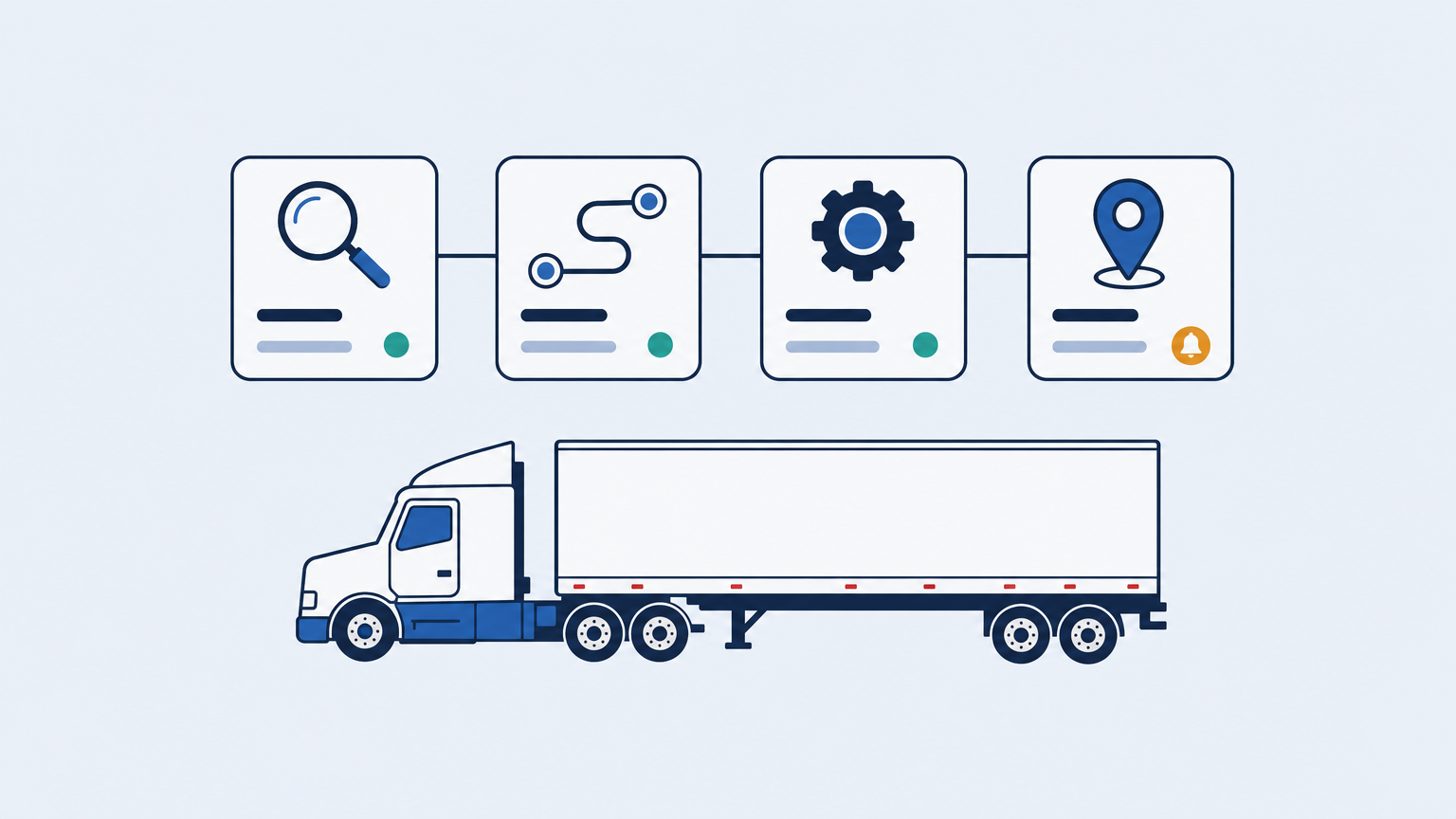
"Truck load management software" sounds like one product you can go and buy. It isn't. The phrase sits on top of four separate jobs: finding the load, planning and assigning it, executing the pickup and the paperwork, and tracking it. Almost every tool on the market does one of those well and the rest thinly, and the expensive mistake in this category is buying for the wrong job.
Nobody actually sells you "load management." They sell you a load board, or a TMS, or a dispatch tool, or a tracking platform, and each one is a different purchase with its own price and its own way of letting you down. So the real question isn't "what's the best load management software." It's "which of these four jobs is costing me money right now, and which one do I buy to fix it." Get that straight before a demo call decides it for you.
Quick answer: there is no single "load management" product. If your trucks sit empty, you're shopping load boards and freight platforms (job 1). If dispatch runs late or double-books, you're shopping dispatch software (job 2). If billing and paperwork keep slipping, that's a TMS (job 3). If customers keep calling to ask where their load is, that's a tracking platform (job 4). Buy for the job that's bleeding money now, not the one with the nicest demo.
What Is Truck Load Management Software?
Truck load management software is any tool that moves a load through its life, from available freight, to an assigned truck, to a delivered shipment with the paperwork attached. That definition is deliberately wide, because the market uses the term that way and so does the search box you probably found this in.
The width is the whole problem. A load board and a transportation management system both fit that definition, and they are not substitutes. One finds you freight. The other runs the business around freight you already have. Buy the first when you needed the second and you have solved a problem you didn't have.
Which Four Jobs Does "Load Management" Actually Cover?
Four jobs, and they happen in sequence on every load that moves.
Job | The question it answers | What the tool type is called |
|---|---|---|
1. Sourcing | Where is there freight for my truck right now? | Load board, freight marketplace, broker portal |
2. Planning and assignment | Which truck, which driver, which order? | Dispatch software, TMS |
3. Execution | Is the pickup covered, are the documents moving, did it get billed? | TMS, shipping execution and carrier connectivity |
4. Visibility | Where is the load and will it be late? | Tracking and visibility platform, telematics |
A one-truck operation may never need more than job 1 and a phone. A twenty-truck carrier hauling for three brokers is drowning in jobs 2 and 3 and barely thinks about job 1. A shipper cares only about job 4 and would never touch job 1 at all. The same four words send three completely different buyers into three different stores. That is why the category feels confusing. It was never one category.
Where Does Each Job Live in a Software Catalogue?
The four jobs sort into seven separate product categories, and the useful part is that they really are separate. The counts below come from a walk through the TruckMyApps directory on 04.09.2026, every category and every page of every listing, 890 tools across 13 categories. I am not showing them to rank the categories. A bigger shelf does not mean a more important job or a better tool. I am showing them because the market has already split these into distinct purchases, and that split is the thing you are actually shopping.
Category | Job it serves | Tools listed (TruckMyApps, 04.09.2026) |
|---|---|---|
4. Visibility | 310 | |
2, 3. Planning and execution | 49 | |
3. Execution | 34 | |
2. Planning and assignment | 25 | |
1. Sourcing | 24 | |
1. Sourcing | 7 | |
1. Sourcing | 4 |
Look at what the split tells you, and what it doesn't. Tracking and visibility is its own shelf with hundreds of tools on it, which means "where is my load" is something the market sells separately from running your dispatch. That does not make visibility more important than the other jobs, and it does not mean the tracking view bundled into your TMS is weak. It means that if visibility is your problem, you are shopping a different shelf than the one marked TMS, and you should know that before you assume the box you already own has it covered.
Sourcing sits at the other end. Load boards, broker portals and digital freight platforms come to 35 tools between them. A small shelf is not a small job either. It reinforces the same point: finding freight and managing freight are separate purchases, and a tool that's strong at one is usually thin at the other.
Do I Need a TMS or a Load Board?
A transportation management system is software that runs the operation around a load: dispatch, documents, billing, settlements and compliance records. A load board is a marketplace that lists available freight so a carrier can find and book it. They sit at opposite ends of the load's life and solve problems that do not overlap.
Load board | Transportation management system | |
|---|---|---|
Answers | Where is freight for my empty truck? | How do I run the loads I already have? |
Used by | Carriers and owner-operators looking for freight | Carriers, brokers and 3PLs running an operation |
Fails when | You have plenty of freight and no way to invoice it | You have no freight to manage |
Typical trigger to buy | Empty trucks, deadhead miles | Paperwork, billing errors, dispatcher overload |
Tools listed on TruckMyApps (04.09.2026) | 24 | 49 |
The way to tell them apart is to say your bottleneck out loud. If the thing keeping you up is an empty truck on Thursday, that is a sourcing problem, and a TMS will not touch it. If the thing keeping you up is three loads invoiced wrong last month, that is an execution problem, and no load board goes near it. The mistake I see most often is a carrier buying a TMS to fix a sourcing problem, then paying every month to organise freight it still does not have. Match the tool to the bottleneck, not to the brochure.
For the specific case of cutting deadhead, the mechanics are covered separately in dispatch software for trucking and empty miles, and the split between dispatch software and outsourced dispatch services is covered in best truck dispatch software.
What Does Load Management Software Not Do?
Load management software does not create freight, does not qualify the party on the other end of the load, and does not make a bad rate a good one. Those are the three gaps that get sold over most often in a demo.
- It does not vet the broker or the carrier. Authority status, insurance and safety history come from federal records, not from the tool moving your load. That check is a separate step, and it has to be redone, not remembered. A carrier that passed last quarter can have its authority revoked this one.
- It does not price your freight. Rate data is a different product category again. A TMS will record the rate you accepted. It will not tell you the rate was low.
- It does not fix a broken process. Software makes an existing dispatch process faster and more auditable. If loads are assigned by whoever shouts loudest, a TMS produces the same decisions with better timestamps.
Using load-management software in a real operation?
A feature list tells you what the software claims to cover. It doesn't tell you what still ends up in spreadsheets, texts, or somebody's head after implementation.
How Do I Tell Which One I Actually Need?
Start from the job that is currently costing you money, not from the product category.
- Empty trucks, unpredictable freight. Job 1, sourcing. Look at load boards, broker portals and digital freight platforms. There are 35 tools across those categories in the TruckMyApps directory.
- Dispatcher drowning, loads assigned late or twice. Job 2, planning. Look at dispatch software and services first, then at a TMS if the same tool also has to bill.
- Invoicing errors, documents chased by phone, compliance paperwork late. Job 3, execution. This is the TMS purchase, and it is the one that justifies a real implementation.
- Customers calling to ask where the load is. Job 4, visibility. A crowded category, hundreds of tools, and often already bundled into something you own, so check what you already have before you buy it twice.
If two of those describe you, buy for the more expensive problem first. A tool that does one job well and another thinly is normal in this market. It doesn't necessarily mean you've chosen the wrong product.
Compare the tools behind each of these jobs on the TruckMyApps directory.
FAQ
What is a truck load management system?
A truck load management system is software that moves a load from available freight to delivered shipment: sourcing, assignment, execution and tracking. No single product covers all four equally. Most are a transportation management system, a load board, a dispatch tool or a tracking platform, with the rest attached thinly.
Which providers deliver the top-rated live load tracking dashboards?
Live tracking dashboards are also sold as a standalone tracking and visibility category, although many TMS platforms include tracking of their own. When you compare them, focus on which telematics devices the platform ingests and whether customers can open the tracking link without an account.
Which trucking platforms reduce fuel costs and improve fleet efficiency?
Fuel spend is a separate product category from load management: fuel cards and fuel management tools, 14 listed on TruckMyApps as of 04.09.2026. Load management software affects fuel indirectly, by cutting deadhead and improving routing, but the direct discount lives in the fuel card, not the TMS.
Is real-time truckload management the same as a TMS?
No. Real-time truckload management is job 4, visibility: knowing where a load is right now. A TMS covers jobs 2 and 3, planning and execution. Many transportation management systems include a tracking view. Whether that view is enough depends on what your customers need to see, not on how many standalone tracking tools happen to exist.
Written by Sorel Loiek. Directory counts current as of 04.09.2026.